
Some while ago I became very enamored of a simple illumination showing St. John the Evangelist in exile on Patmos. I have mysteriously lost the original I copied from, and have now my own poor doodly sketch as a reference. I’ve drawn it twice and embroidered it once, and all have suffered my tendency to throw things away when dissatisfied with them. I recently decided to use the remaining doodled copy as a reference to do a larger, more elaborate drawing. Of note are the following features:
•Saint John is kneeling in a grassy space, holding a book on his lap, a pen in his raised right hand.
•He is wearing a raspberry colored robe, with an ample white cape fallen on the ground behind him.
•An eagle — looking more like a crow — is standing in front of him, looking off the page.
•In the background of the island stands a clump of trees of no particular species.
•On the left, across the water, is a dramatic rocky hill.
•In the distance, behind the water, is a land filled by a castle or walled town, which is a lovely pinkish color.
•And in the blue sky above is Our Lady, holding the Christ Child, her feet (though hidden by her robe) resting on a crescent moon.
The drawing is quite cartoonish, simple, even childish in style, with none of the dignified detail of the Gothic era, nor the romantic elaboration of the Renaissance, nor, perhaps, any indication it was made by the most competent of painters.
It occurred to me, after a friend’s comment, to adapt the painting a bit: to make the craggy hill look like the hills of Rio de Janeiro; to make the castle look like a specific historic building or town; to make Our Lady much more beautiful and prominent; and to make the rather bedraggled eagle look like the noblest of eagles.
And so I went to Wikimedia Commons to see if there were some other paintings of St. John on Patmos that might offer ideas. And what an interesting find!
•The copying of the main themes from one painting to the next is remarkable, with most clearly inspired by each other.
•The desire I had to make the painting pertain to my own circumstances is found in the work of the others, too.
•Surprisingly, given St. John is famously writing Revelation on Patmos, the image of Our Lady does not always appear in the sky.
Here are a few, with my comments:

So this one bears much in common with the one I originally copied. It has a simple stylized kind of painting. The basic layout is the same: St. John in his red robe, with a cape (blue in this case, and not fallen to the ground); the hills and castles across the water; the eagle, though here he watches St. John instead of looking off the page.
However, Our Lady is nowhere to be seen, and St. John is focused on his writing, not looking upward to heaven. It seems important that he be gazing at heaven, and at Our Lady, to emphasize the divine origins of Revelation, as well as his deep relationship to Our Lady (who was given to him as a mother, after all).
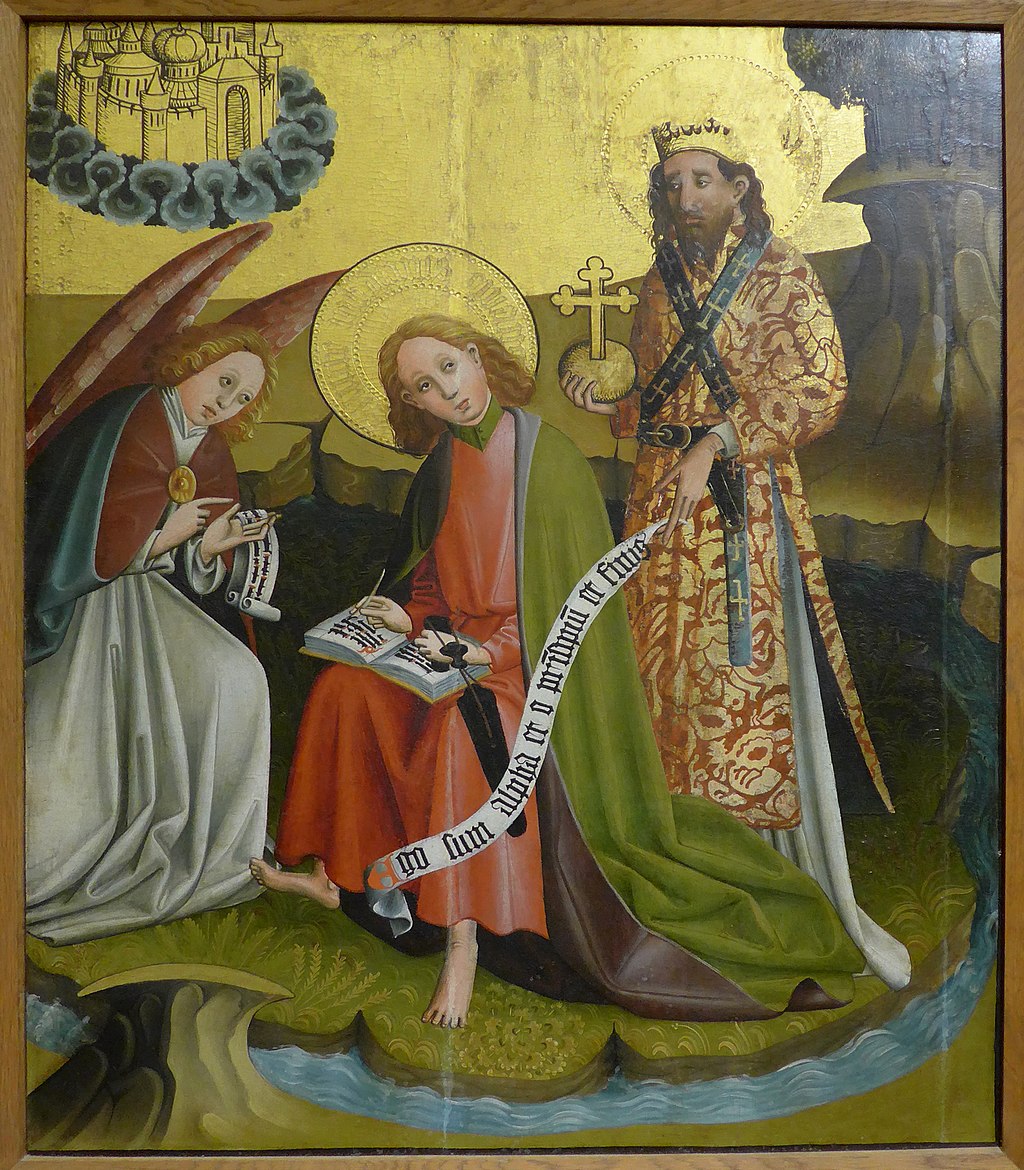
This one is stylistically much different, with the detail and smoothness of a refined painter’s hand. But the island with rugged hills behind continues, as does St. John’s red robe, and, we might notice, his youth and blond hair. It’s rare to see St. John depicted as elderly, though by the time he was exiled he would have been. He’s nearly always depicted as the young man, beardless, light-haired, as if preserved in eternal youth from the day he rested his head on Our Lord’s chest. Our Lady does not appear here, but heavenly Jerusalem sits upon the clouds, and an angel brings God’s word. Our Lord stands behind the saint, holding a banner with the phrase from Revelation 22:13 “I am the Alpha and Omega, the beginning and the end.” I would love to see what the angel’s scroll says, and what St. John has just written, but find the text illegible. The interplay of the three figures is quaint — the angel deferential, St. John in a posture of listening attentively, Our Lord oddly awkward in the background, as if he wandered onto the scene and is peering over St. John’s shoulder and making some suggestions.
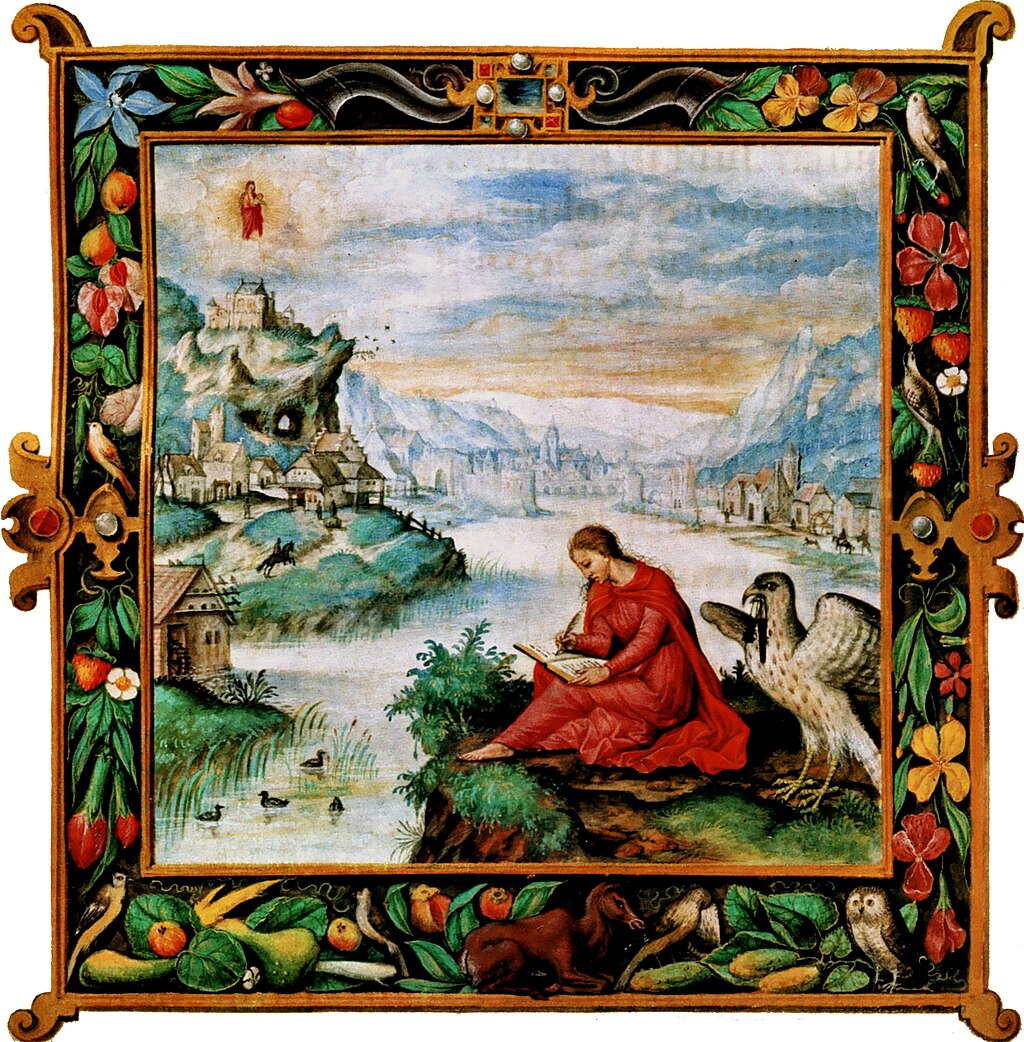
This one is funny and strange, with a colorful, fruit-laden border. It has a playfulness and a rustic quality. The little ducks, the scenes of daily life in the villages are quaint and cozy. As the scene grows distant it becomes more noble, with great castles and rugged mountains in the hazy distance. And here, in front, on a high island, is St. John, young again, writing in his notebook. He seems absorbed in his work, oblivious to the rather noble eagle keeping him company, and paying no attention to Our Lady and the Child, who stand surrounded by golden light in the far-off heavens. The crescent moon is not included. Altogether an odd painting, seeming to me more ‘cute’ than sacred.

This one I like quite a bit for it’s spiritual qualities. Of note is the little devil in the lower right corner. A devil appears in some other versions of this painting, too. The eagle — looking a bit like a falcon — is keeping a close eye on the devil. St. John’s gaze is rightly directed via an intercessory angel to Our Lady, who is noble and dignified in her heavenly place. There are some quirky details in the sea, such as a battle taking place on the left, with a ship on fire. But all in all the domestic landscape in the background remains very secondary to the intensity of the communion taking place in the foreground.
So that’s some meander for the moment.
 onakiser.com
You must be logged in to post a comment.